
Responsible Gambling at MyStake Argentina
This page about responsible gambling at MyStake Argentina is intended for adults in Argentina and is provided strictly for informational purposes. It is not a medical or psychological assessment and does not replace professional guidance. Online casinos and sports betting may be forms of entertainment, but they always involve real money and can create emotional pressure, frustration, or impulsive decisions.
For this reason, staying in control does not depend solely on “willpower.” It also requires setting limits before gambling, tracking spending, ending a session on time, and recognizing changes in behavior. The aim is to provide practical criteria that help prevent gambling from affecting your budget, sleep, work, or relationships. When financial consequences, persistent anxiety, secrecy, or difficulty stopping appear, the priority is no longer to gamble better but to seek help.
What Responsible Gambling Really Means
Responsible gambling does not necessarily mean avoiding every bet. It means maintaining control over three resources: money, time, and attention. Gambling remains recreational when the amount has been decided in advance, the session has a clear ending, and both winning and losing can be tolerated without affecting the rest of the day.
No system removes chance or turns betting into a stable source of income. A gambling session should not determine whether a bill gets paid, a family activity is cancelled, or you sleep properly that night. If the result affects your mood, budget, or relationships, the activity has already moved beyond its recreational role.
Before entering MyStake, a useful routine is to:
- Set a maximum amount.
- Decide how long the session will last.
- Avoid increasing the limit while gambling.
- Close the platform when either limit is reached.
Creating a Realistic Gambling Budget
Your budget should be defined before the first deposit. Waiting to “see how the session goes” leaves the decision in the hands of excitement, anger, or the expectation of recovering losses. The limit must fit alongside all monthly expenses and remain unchanged even when an attractive promotion appears.
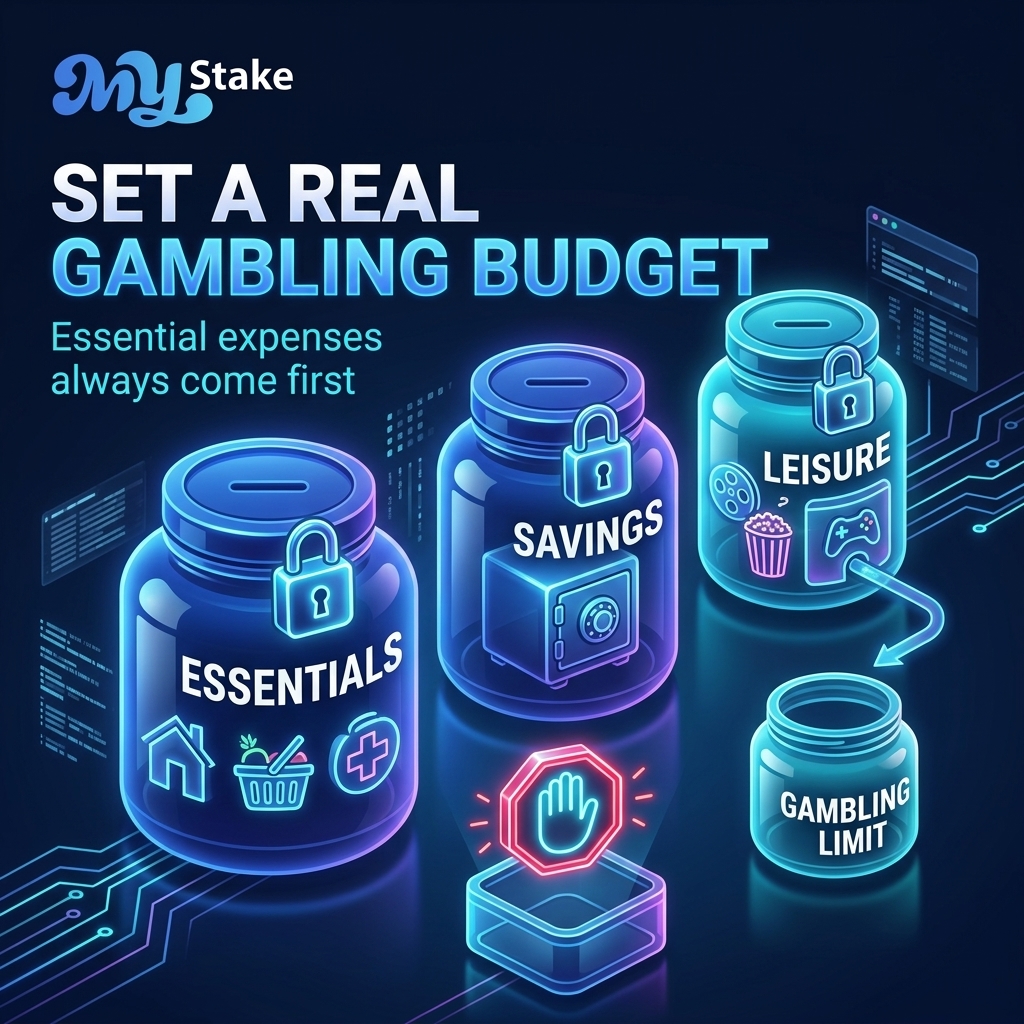
To calculate it, separate your obligations, savings, and leisure budget. Gambling funds may come only from the final category.
| Type of money | Can it be used for gambling? | Reason |
|---|---|---|
| Rent, service charges, or housing payments | No | These are essential expenses. |
| Food, utilities, and transport | No | They support daily life. |
| Instalments, loans, or credit-card payments | No | Using this money increases the risk of debt. |
| Medical treatment and medication | No | Health takes priority. |
| Emergency savings | No | They must remain available for unexpected costs. |
| Budgeted leisure money | Only a portion | Losing it must not affect the rest of the month. |
Money You Can Afford to Lose
The simplest test is to imagine that the entire amount disappears on the first bet. Would your rent still be covered? Would you still have money for food, transport, utilities, healthcare, and family commitments? If the answer to any of these questions is no, the limit is too high.
This does not mean that losing should feel pleasant. It means that the loss does not interfere with obligations or force you to use a credit card, borrow money, or reduce essential spending. A reasonable amount is often lower than the first figure that comes to mind. Once it has been used, it should not be replaced until the next budget period.
The Jar Method
The jar method separates money by purpose using accounts, digital wallets, envelopes, or financial categories. This prevents entertainment money from becoming mixed with essential funds.
A simple monthly structure may include:
- Essential obligations and living expenses.
- Savings and an emergency fund.
- General leisure spending.
- A limited portion of the leisure budget for betting or casino games.
For MyStake Argentina, all gambling transactions should come exclusively from the fourth “jar.” When it reaches zero, gambling stops. Money should not be transferred from the other categories, and the following month’s budget should not be used in advance.
This physical or digital barrier reduces the likelihood of impulsive decisions involving essential funds.
Never Finance Gambling With Debt
Depositing borrowed money completely changes the level of risk. A loss is no longer only a leisure expense: it becomes a future obligation involving deadlines, interest, or pressure from another person. For this reason, gambling should never be funded using credit, salary advances, personal loans, or money reserved for paying a credit-card bill.
Selling possessions, delaying bills, or borrowing money without explaining its purpose are also serious warning signs. No bonus compensates for this risk. Debt extends the consequences of a loss and may encourage further gambling. If there is no personal money available within the leisure budget, there should be no deposit.
Managing Session Length
Time also acts as a financial limit. The longer a session continues, the easier it becomes to lose track of spending, repeat bets automatically, or react impulsively to a losing streak. Fatigue also reduces concentration.
Set a start time and an end time without linking the end of the session to the balance. Stopping “when I win it back” or “after one final bet” leaves the session open-ended. A better rule is to stop when the alarm sounds, even when a round is still pending or the current result is positive.
Short Sessions Are Better Than Marathons
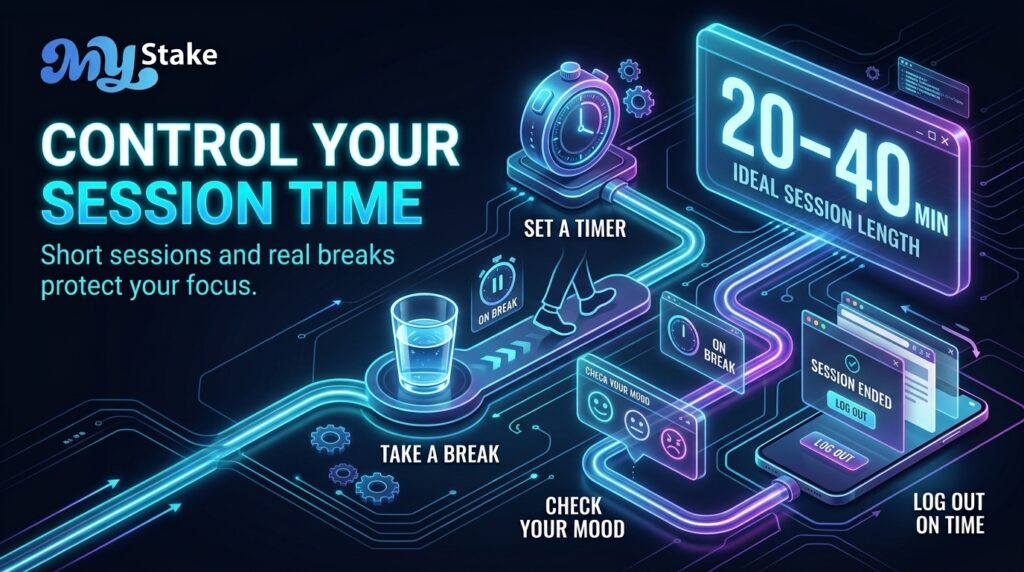
A conservative approach is to gamble in blocks of 20 to 40 minutes, with a genuine break between them. A break does not mean switching from the casino to sports betting within MyStake. You should stand up, look away from the screen, drink water, and move away from the device.
Continuous sessions lasting two hours or more increase fatigue. To avoid them:
- Set an alarm before starting.
- Close the browser tab or web app during the break.
- Do not use the result as an excuse to extend the session.
- Write down the actual time you stopped.
- Avoid starting a session close to bedtime.
If it is difficult to respect even a short break, that is already important information about your level of control.
Physical Signs That You Need a Break
The body often provides warning signs before a person admits they are tired. Neck tension, dry eyes, headaches, tingling fingers, or delaying a bathroom break are practical indicators. Rapid breathing, clenching the jaw, and checking the balance compulsively also count.
These signs should not be negotiated with. They should trigger an immediate stop rather than become a reason to play “a few more rounds.” An effective break includes movement, hydration, and several minutes without looking at odds, games, or promotions.
Recognizing Signs of a Problem
Loss of control often begins with small changes: spending more time thinking about gambling, making less-planned deposits, becoming irritable, or avoiding conversations. One isolated sign does not define a problem, but repeated signs deserve attention.
| Area | Warning sign | Responsible response |
|---|---|---|
| Behavior | Thinking about gambling during work, study, or meetings | Take a break and track how often it happens. |
| Finances | Increasing amounts or making several unplanned deposits | Block additional deposits and review your statement. |
| Emotions | Irritation, anxiety, or a need to recover losses | End the session without trying to compensate. |
| Relationships | Lying, hiding spending, or cancelling plans | Speak to someone you trust. |
| Routine | Sleeping less or neglecting responsibilities | Stop gambling and seek guidance. |
Behavioral Signs Only You May Notice
Some warning signs appear before anyone else notices them. Constantly thinking about the next bet, organizing sessions during work, or checking odds while talking to someone are examples. Irritability when gambling is not possible and feeling that every free moment must be used to enter the platform are also relevant.
Secrecy matters as well. Deleting browsing histories, minimizing amounts, or changing the subject can indicate a problem. It may help to record for one week how much time gambling occupies in your thoughts and actions. If it dominates your routine, taking a break is reasonable.
Financial Traces in Your Bank Statement
A bank statement may reveal patterns that memory tends to minimize. A single deposit may appear small, but several transactions together show the true amount spent. Warning signs include increasingly frequent deposits, progressively larger amounts, the use of credit, and having no savings left at the end of the month.
A monthly review should add all deposits, subtract withdrawals, and show the net result without counting bonuses as personal money. If several deposits appear each week or essential bills are delayed, new transactions should be stopped and the entire limit reviewed.
Relationship Warning Signs at Home
People close to you may notice changes before you do. Arguments about time or money, cancelled plans, reduced participation in family responsibilities, and defensive responses to ordinary questions may appear. Lying about amounts or frequency is a more serious warning sign than the result of one session.
When someone raises a concern, focus on the facts: how much was spent, how much time was used, and which commitments were delayed. The conversation should happen away from the platform, without justifying losses through possible future winnings. If the conflict continues, outside support may be needed.
How Chasing Losses Develops
Chasing losses often follows a recognizable sequence. First, there is a negative result. Then comes the idea that one more bet could restore the balance. The stake increases, another deposit is made, or a bonus is activated to extend the available balance. If the result is negative again, the decision may become “all or nothing.” Within minutes, a limited loss can become significantly greater harm.
Each step is taken under increasing pressure. The bet stops following the budget and starts responding to urgency. No technique guarantees the recovery of losses, and increasing exposure only increases the risk.
The practical response is to stop as soon as the first urge to recover appears:
- Do not make another deposit.
- Log out.
- Move away from the device.
- Record the actual loss.
- Do not return until the chosen cooling-off period has ended.
How Bonuses Can Extend Sessions
Promotions may provide additional balance, free spins, cashback, or reload offers, but they are not money without conditions. They are designed to encourage activity and longer engagement. At MyStake, each offer should be assessed according to its mechanics rather than only the displayed percentage.
A wagering requirement means that a certain amount must be bet before the related balance can be withdrawn. The expiry date adds pressure, and maximum-bet limits may prevent the requirement from being completed quickly. Activating a promotion without reading these rules may lead to longer sessions and greater spending than planned.
Before accepting a bonus, check:
- How much must be deposited.
- The total amount that must be wagered.
- How much time is available to complete the requirement.
- Which games or bets contribute.
- Whether a maximum bet applies.
- What happens to the balance if the bonus is cancelled.
If the conditions do not fit the budget and time limits already established, the responsible choice is not to activate the promotion.
Casino-Side Safety Tools
Control tools work best when configured in advance. They do not remove risk, but they create additional barriers against impulsive decisions. Availability varies between operators and jurisdictions.
MyStake publishes dedicated access to its Responsible Gaming and Self-Exclusion sections. For longer exclusion periods, the platform states that requests are submitted through customer support and may cover periods ranging from six months to five years. This measure affects the MyStake account and does not replace any provincial exclusion registers that may exist in Argentina.
| Tool | What it limits | Most appropriate use |
|---|---|---|
| Deposit limit | The amount of money added during a period | Preventing impulsive deposits. |
| Betting limit | The total amount wagered during a period | Controlling gambling volume. |
| Loss limit | The net negative result | Preventing losses from escalating. |
| Break or time-out | Access during a short period | Interrupting an impulsive phase. |
| Session reminder | Time and sometimes account activity | Restoring perspective. |
| Self-exclusion | Access for a longer period | Situations involving loss of control. |
Deposit, Betting, and Loss Limits
These three limits apply to different variables. A deposit limit restricts how much money can be added per day, week, or month. A betting limit controls the total wagering volume, including when the same balance is reused. A loss limit focuses on the net negative result during a specific period.
The amount should be chosen while calm and set below the level you might try to increase during a session. Some platforms require a waiting period of 24 or 48 hours before a limit can be increased. This delay is a protective measure. When there is concern, it is safer to reduce the limit or block deposits.
Breaks and Session Reminders
A time-out temporarily blocks access and may last from one day to several weeks. It can be useful when you are tired, angry, making repeated deposits, or struggling to respect session times. The break should be used to review your budget and reasons for gambling.
Session reminders or reality checks show how much time has passed and, where available, information about the balance or activity. They should not be dismissed automatically without reading them. If MyStake does not display the control you need, customer support can explain the current options. For a stronger barrier, self-exclusion may be appropriate.
Full Self-Exclusion
Self-exclusion blocks the account for an extended period and generally cannot be cancelled before the chosen term ends. MyStake’s publicly available information includes exclusion periods ranging from six months to five years through its support service.
Argentina also has mechanisms administered by provincial regulators. Their scope depends on the jurisdiction. Some registers cover authorized operators within a particular city or province and establish their own time periods. A person with accounts on several platforms may therefore need to combine operator-level exclusion with a local register. When control has already been lost, it is not advisable to keep one account open “just in case.”
Protecting Children Around Your Devices
An open session, saved password, or stored payment card reduces barriers for minors. In households with shared devices, protection should form part of the normal digital routine.
Basic measures include:
- Log out of MyStake after every use.
- Do not share passwords or verification codes.
- Disable autofill for payment details.
- Avoid saving cookies that enable automatic login.
- Do not gamble in front of children or teenagers.
- Use separate profiles and parental controls.
- Review promotional notifications and emails visible on shared screens.
It is also important to explain that gambling is not a way to earn money and is not an activity for minors. Adult behavior matters: normalizing frequent betting in front of children may reduce their perception of risk.
When to Ask Someone Else for Help
Self-help may no longer be sufficient when there is debt, delayed bills, conflict, lying, anxiety, insomnia, or an inability to follow limits. You do not need to wait for an extreme crisis before seeking support.
A first step may be to tell someone you trust and temporarily block access to money that could be used for deposits. Specialist guidance should then be considered. If thoughts of self-harm, intense despair, or immediate danger appear, leave the platform and seek local emergency care without remaining alone with the problem.
Local Resources in Argentina
Argentina regulates gambling mainly by jurisdiction, so available resources vary between provinces and the Autonomous City of Buenos Aires. In CABA, LOTBA provides information about responsible gambling, self-assessment, support, and self-exclusion. In the Province of Buenos Aires, the Provincial Institute of Lotteries and Casinos provides a prevention program, support centers, and self-exclusion forms.
Official programs are also available through the Córdoba Lottery and the Provincial Institute of Games and Casinos of Mendoza. Because contact details, forms, and conditions may change, consult the official website of the authority corresponding to your place of residence. Provincial self-exclusion and MyStake self-exclusion serve different purposes and may be used together.
International Support Groups
International organizations provide self-assessment tools, peer meetings, forums, and online guidance. Gamblers Anonymous has a presence in Argentina. GamCare provides resources and international links, BeGambleAware publishes prevention materials, and the Responsible Gambling Council offers educational content.
Availability in Spanish varies between organizations and services. Before sharing personal information, confirm that you are using the official website. These resources may serve as a first point of contact or as additional support, but they do not replace professional care when there is serious debt, emotional deterioration, or a risk to personal safety.
Final 18+ Reminder
All content on this page is intended exclusively for people aged 18 or older. In Argentina, provincial and CABA authorities restrict legal access to betting and online casino services to adults. The minimum age is not a formality: it is intended to prevent children and teenagers from being exposed too early to products involving money, chance, and high-frequency stimulation.
Families should keep accounts, passwords, and payment methods out of the reach of minors and use parental controls on shared devices. For adults, the final principle remains the same: gamble only as entertainment, use your own money, set limits in advance, and maintain the genuine ability to stop. If that control is lost, the responsible decision is to stop gambling and seek support.